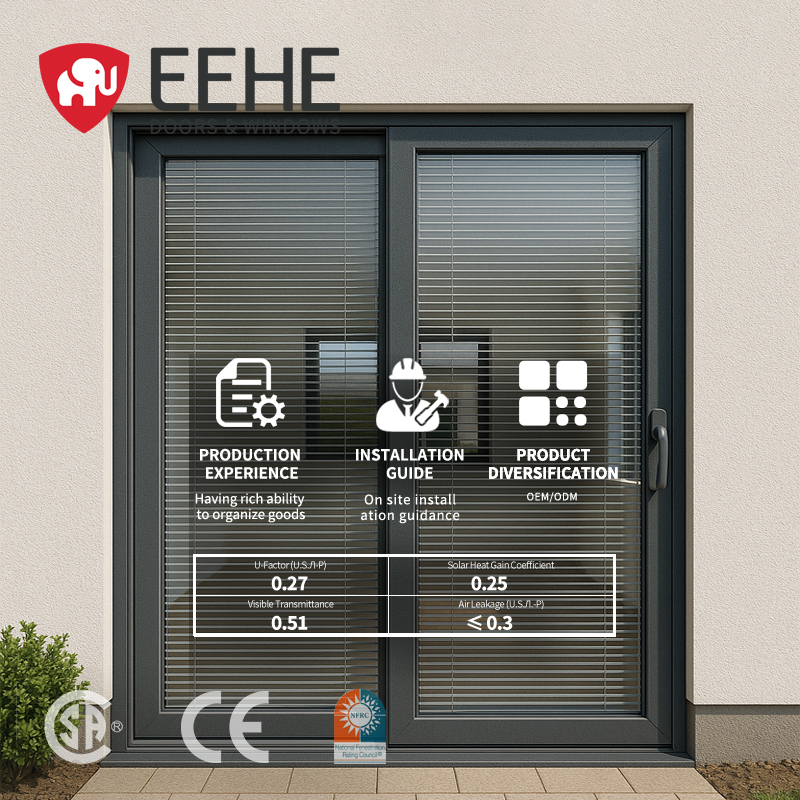
The Phoenix metropolitan area—encompassing Scottsdale, Paradise Valley, Tempe, Mesa, and Chandler—represents one of the most demanding climatic environments in North America for architectural building envelopes. Characterized by extreme summer temperatures frequently topping 115°F (46°C), intense solar irradiance exceeding 3,800 hours of annual sunshine, and dramatic diurnal temperature swings, fenestration systems deployed in Maricopa County face grueling thermal stress. For US general contractors, fenestration distributors, and commercial real estate developers, procuring aluminum sliding systems directly from premier Chinese wholesale manufacturers in Foshan offers an unprecedented balance of structural strength, thermal performance, and capital efficiency.
However, importing wholesale aluminum doors and windows into Arizona requires rigorous attention to structural engineering and building science. Standard non-thermal aluminum frames exhibit high thermal conductivity ($k \approx 160 \text{ W/m}\cdot\text{K}$), turning door sills and jambs into thermal bridges that rapidly transfer external desert heat straight into air-conditioned interior spaces. To meet the stringent 2021 International Energy Conservation Code (IECC) enforced across the Valley of the Sun, imported aluminum sliding systems must achieve an overall U-Factor of $\le 0.32$ and a Solar Heat Gain Coefficient (SHGC) of $\le 0.23$.
Thermodynamic Behavior of Aluminum in Desert Conditions
Direct exposure to desert sun can elevate exterior surface temperatures on dark anodized or powder-coated aluminum profile extrusions up to 180°F (82°C). Without advanced thermal isolation, this causes substantial linear thermal expansion. Aluminum expands at approximately $23 \times 10^{-6} \text{ K}^{-1}$. Across a 20-foot multi-slide patio door assembly, thermal variance between peak afternoon solar saturation and cool nighttime desert temperatures can produce frame expansion and contraction of up to 3/8 inch. If frame extrusions are not engineered with high-tensile Polyamide PA66 glass-fiber-reinforced thermal breaks, frame warping, seal degradation, and operational binding are inevitable.
PA66 Thermal Isolation
Equipped with 24mm to 34mm polyamid thermal break strips, effectively separating interior and exterior aluminum profiles to stop direct solar heat conduction.
Spectrally Selective Low-E3/E4
Double and triple insulated glass units (IGUs) coated with triple-silver Low-E layer configurations to block up to 95% of infrared radiation and UV rays.
Monsoon & Dust Sealing
Triple-continuous EPDM sealing gaskets combined with hidden drainage channels engineered to withstand severe Sonoran haboobs and sudden monsoon downpours.