High-Performance Aluminum Tilt & Turn Window Systems
Engineered with multi-chamber thermal breaks, acoustic laminated glazing, and heavy-duty multi-point hardware for global B2B projects.
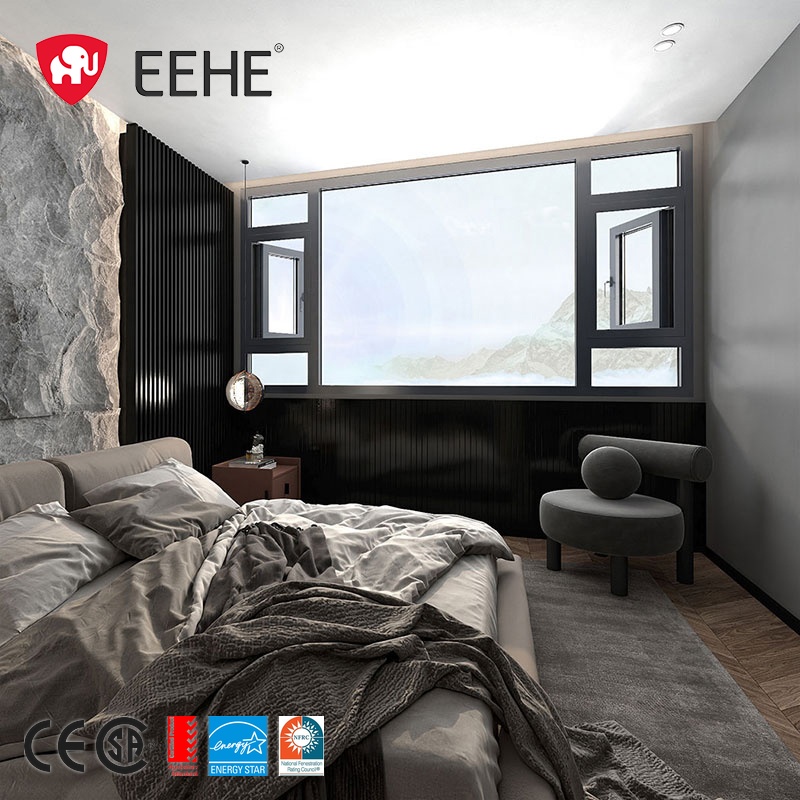
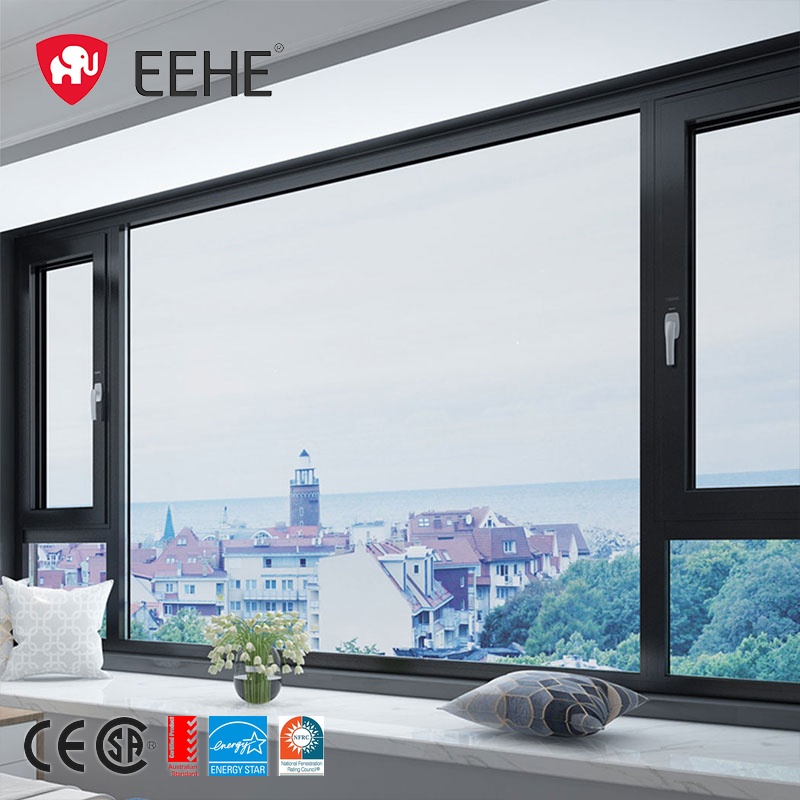
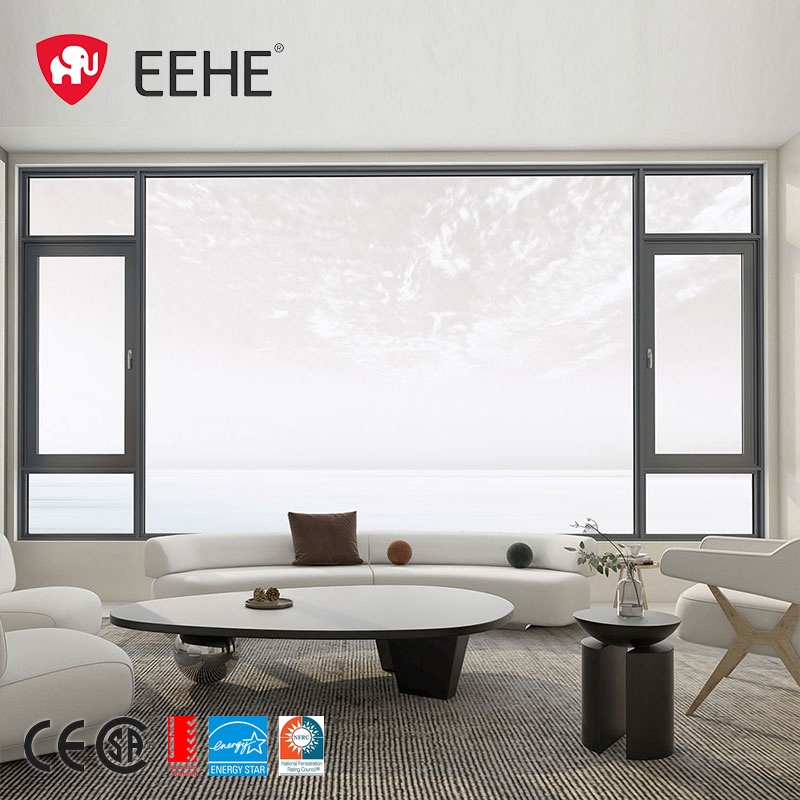

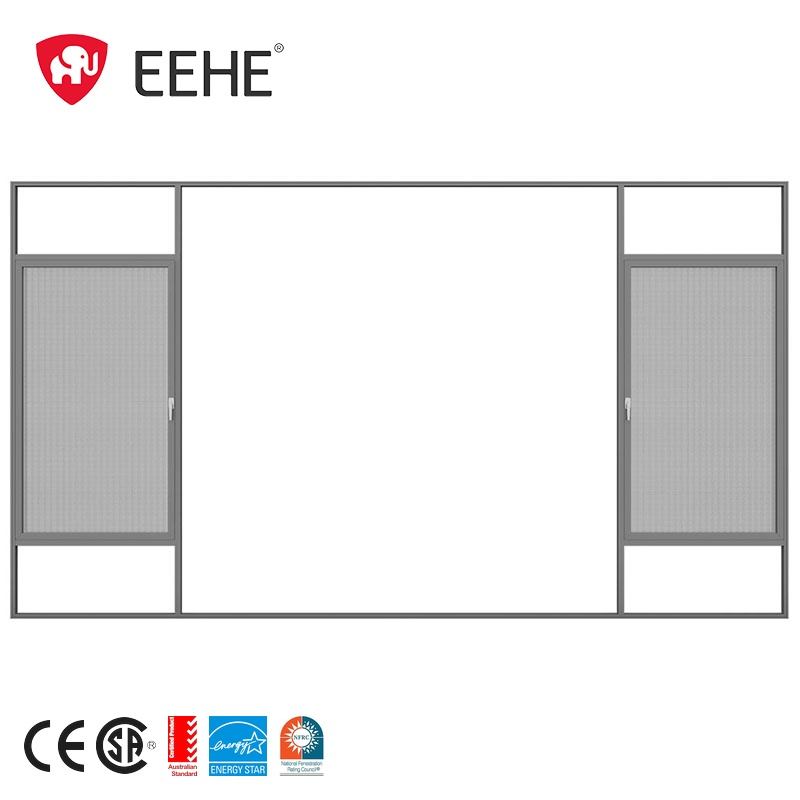
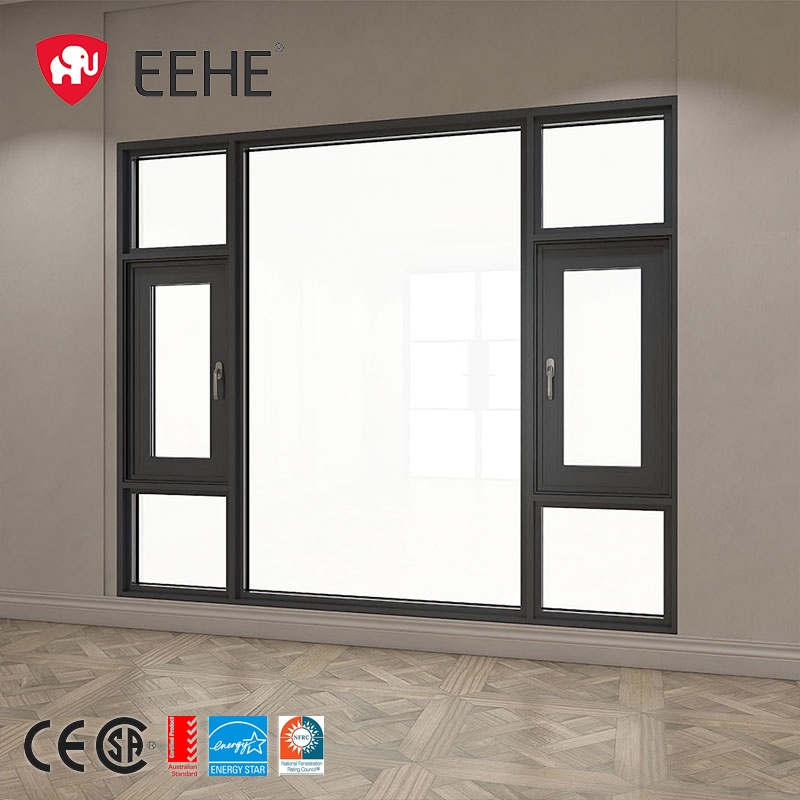

Engineering Principles of European Dual-Action Tilt & Turn Fenestration
Understanding structural kinematics, thermal bridge abatement, and multi-chamber compression technology for high-rise and luxury residential builds.
1. Kinematic Dual-Function Mechanism
The modern tilt-and-turn window represents a high watermark in architectural hardware engineering. Operating via a single perimeter gear-driven handle, the sash moves through two distinct modes:
- Inward Tilt (Top Ventilation): Sashes tilt inward by 100mm to 150mm at the top, enabling continuous draft-free air exchange via convection currents while maintaining absolute security against forced entry and rain ingress.
- Full Inward Swing (180° Turn): Turning the handle to the 180° vertical position disengages top stay-arms, converting the sash into an inward-swinging casement. This allows 100% opening area clearance and effortless interior cleaning of exterior glass surfaces.
For commercial developers and façade consultants, specifying high-load hinge pivots rated for sashes up to 150kg to 300kg is critical to prevent sash sag over 50,000 operational cycles.
2. Thermal Break Physics & Energy Metrics
Aluminum is natively highly conductive ($k \approx 160 \text{ W/m}\cdot\text{K}$). To achieve stringent U-factor thresholds ($Uw \le 0.8 \text{ to } 1.2 \text{ W/m}^2\text{K}$) for passive house standards, Guangdong SPD utilizes continuous PA66-GF25 (Polyamide 66 reinforced with 25% glass fiber) thermal barrier strips.
By separating exterior and interior extrusion chambers with low-conductivity polyamide ($k \approx 0.3 \text{ W/m}\cdot\text{K}$), combined with multi-cavity insulation inserts (AEROGEL or expanded Polyurethane foam), thermal transfer across the fenestration frame is reduced by up to 85%.
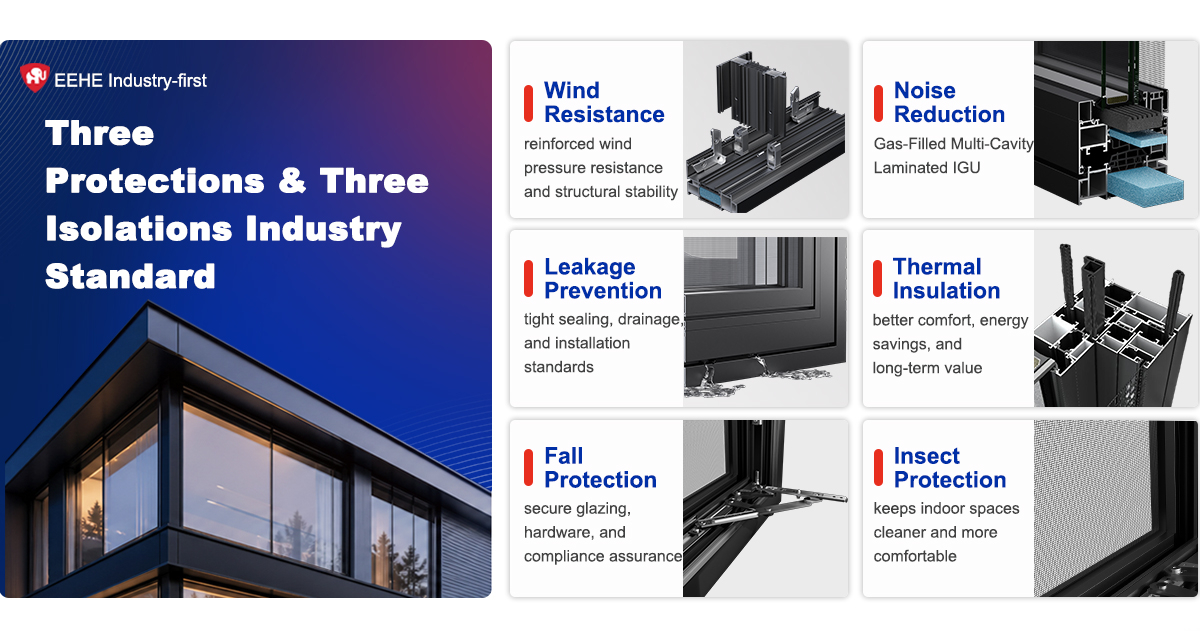
When paired with Low-E insulated glass units (IGUs) filled with 90%+ Argon gas and warm-edge composite spacers, these assemblies prevent interior condensation, drastically reduce HVAC thermal load, and satisfy strict energy codes including US NFRC, Canadian CSA, and Australian AS1288/AS2047.
Multi-Point Perimeter Locking
Utilizes circumferential mushroom-head locking cams that engage heavy-duty steel strike plates around all four sash edges, delivering class-leading RC2/RC3 burglar resistance and uniform gasket compression.
Triple Gasket Air-Tightness
Features continuous EPDM weather-stripping across primary, secondary, and center acoustic sealing lines, meeting Class 4 air permeability (EN 12207) and 1050 Pa water tightness (EN 12208).
Acoustic Attenuation (STC 45+)
Incorporates asymmetric laminated acoustic glass build-ups (e.g., 6mm Low-E + 1.52PVB + 6mm Clear + 12Argon + 8mm Sound-damping) to damp sound waves across low and high frequencies.
Comparative Performance Matrix: Tilt & Turn vs Standard Systems
A rigorous specification guide for structural engineers, project managers, and procurement officers.
| Performance Parameter | Guangdong SPD Tilt & Turn Series | Standard Outswing Casement | Conventional Sliding Window | Compliance Standards |
|---|---|---|---|---|
| Thermal Transmittance ($Uw$) | 0.8 - 1.3 W/m²K | 1.6 - 2.2 W/m²K | 2.4 - 3.2 W/m²K | NFRC / ENERGY STAR / CE |
| Air Permeability | Class 4 (ASTM E283) | Class 3 | Class 2 | EN 12207 / AS2047 |
| Water Penetration Resistance | 700 - 1050 Pa | 450 - 600 Pa | 250 - 350 Pa | EN 12208 / CSA A440 |
| Acoustic Isolation (Rw/STC) | STC 42 - 48 dB | STC 32 - 38 dB | STC 26 - 30 dB | ISO 717-1 / ASTM E90 |
| Wind Load Resistance | Service Load: ±5000 Pa | ±3500 Pa | ±2000 Pa | ASTM E330 / AS2047 |
| Hardware Load Rating | Up to 300 kg / sash | Up to 80 kg / sash | Up to 120 kg / sash | EN 13126-8 Structural Test |
| Security Rating | RC2 / RC3 Anti-Burglary | Standard Latch | Basic Flush Lock | DIN EN 1627 Certification |
Future Procurement Trends in Architectural Aluminum Windows (2025–2030)
Key market vectors shaping commercial procurement strategies, material selection, and environmental compliance for global B2B buyers.
1. Ultra-Narrow Sightlines with Concealed Hardware
Modern architectural trends demand maximal glazing surface ratios and minimal visible aluminum frames. Next-generation tilt-and-turn windows integrate 3D-adjustable concealed hinges embedded entirely within the profile rebate channel, eliminating external hinge caps while preserving 180-degree opening angles and heavy load capacity.
2. Vacuum Insulated Glass (VIG) Integration
Replacing traditional thick triple glazing, thin-profile Vacuum Insulated Glass (VIG)—featuring a 0.1mm micro-vacuum gap between two glass panes—delivers ultra-low U-values ($Ug \approx 0.4 \text{ W/m}^2\text{K}$) with a fraction of the weight. This innovation reduces overall sash weight, extending hardware longevity dramatically.
3. Decarbonized Low-Carbon Extrusions
With EU Carbon Border Adjustment Mechanism (CBAM) and strict Scope 3 emission targets, global importers are prioritizing suppliers utilizing hydro-powered aluminum smelting or high-recycled-content extrusions (>75% post-consumer scrap). Guangdong SPD provides verified Environmental Product Declarations (EPDs) for sustainability verification.
4. Automated Micro-Ventilation & Smart Building Integration
The convergence of smart home automation and commercial Building Management Systems (BMS) has accelerated demand for motorized tilt actuators. Electrically operated tilt-turn sashes sync with indoor CO2 and humidity sensors, tilting automatically to flush air when IAQ thresholds are exceeded, and closing during rainfall events.
Guangdong SPD Doors & Windows Technology Co., Ltd.
Situated in Dali Town, Foshan—the epicenter of China's premium architectural aluminum supply chain—Guangdong SPD operates a state-of-the-art 100,000 m² manufacturing plant supported by 560 skilled professionals. Our plant has been verified on-site by SGS, proving robust production governance and technical capability.
- Full OEM/ODM Fabrication: Customized profile extrusions, glass build-ups, powder-coated finishes (PVDF, Anodized, Wood-grain, RAL colors).
- 6 Proprietary Patents: Structural sealing, corner crimping stability, and multi-drainage chamber engineering.
- Global Code Compliance: Tested and certified series compliant with North American NFRC & CSA, Australian AS2047, and European CE standards.
- Strict Quality Assurance: 100% finished-product dimensional, drainage, and hardware operational checks prior to export container loading.
Frequently Asked Questions for Sourcing Windows from China
Essential technical and logistical answers for project managers, importers, and general contractors.
Why choose Tilt & Turn windows over standard outward casement or sliding windows?
What technical drawings or schedules are required to obtain an accurate quotation?
- Elevations and Window/Door Schedules indicating structural rough opening sizes.
- Required profile specifications (Thermal break depth, profile wall thickness such as 1.4mm, 1.8mm, or 2.0mm).
- Glass configuration (e.g., 6mm Low-E + 12Ar + 6mm Tempered, laminated acoustic glass, or tinting).
- Surface finish (Powder coating color code RAL, Fluorocarbon PVDF, or Anodized).
- Destination port for container logistics planning.
Are SPD window systems certified for North American and Australian building codes?
How does SPD protect glass and powder-coated profiles during ocean transit?
- Aluminum profiles are wrapped in protective PE anti-scratch film and thick foam corner pads.
- Glass units are cushioned with rubber shock-absorber blocks.
- Complete windows are packed inside custom fumigation-free solid plywood crates or heavy-duty A-frame steel racks suitable for forklift container loading and unloading.
What is the typical production lead time for commercial or custom villa orders?
Can SPD supply matched hardware brands like Siegenia, Roto, or Hoppe?
Ready to Partner with China's Premier Tilt & Turn Window Manufacturer?
Send your project blueprints or window schedule to Guangdong SPD's engineering department today. Receive a free engineering review, CAD drawing verification, and detailed project estimate within 24 hours.